
The Last Mile Part 1
The Last Mile
October 22, 2025
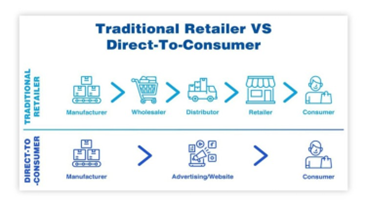
“The Last Mile” is the term used to define the movement of product to where consumers purchase or receive products. In this piece, we will review the three primary approaches, Direct to Consumer (DTC), Warehouse Direct to Retailer (WD) and Direct Store Delivery (DSD). Each has advantages and disadvantages from logistics and staffing cost to reach the consumer/retailer. In part 1, we use Olipop and Poppi as examples to demonstrate how each approach can be used successfully during the development of a brand. We will then discuss how DTC has been used to launch and build new brands introduced to the market. Part 2 will focus on Warehouse Direct and DSD.
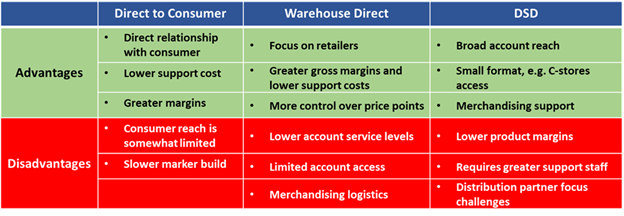
Several brands have found success, while many others have failed entering the market through one of these approaches mentioned above. Each comes with its own set of advantages and disadvantages, which include:
Alternative Approaches for Reaching Consumers
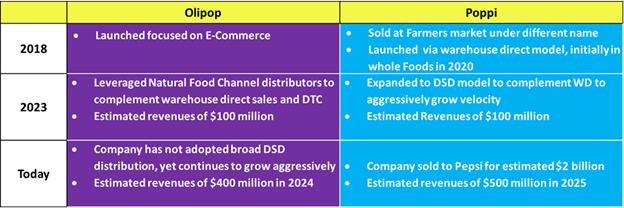
In many cases, brands begin with online sales, then move onto large-format retail shelves (such as grocery and club stores) before expanding into DSD to reach small-format outlets (convenience and independent stores) and non-traditional accounts. A clear example of this evolution can be seen in the prebiotic soda category dominated by Poppi and Olipop. Both brands launched in 2018 but pursued different initial strategies: Olipop emphasized DTC, while Poppi relied on a warehouse direct model. While Olipop has transitioned into an omni-channel approach to market, Poppi has chosen to evolve into a DSD model. It is interesting to follow the trajectory of both companies.
Distribution Evolution
Although some successful companies started with Direct to Consumer, the vast majority of the companies that began using this approach fail as building awareness in a crowded space can be difficult. That said, for some this channel is less costly than retail and offers an opportunity to connect with consumers and develop a following before approaching retailers. In order to get noticed, a well-defined and differentiated strategy is required to succeed. Some companies that have succeeded by initially going DTC such as Olipop, Hint and G-Fuel are highlighted below:
- Olipop built brand awareness between 2018 and 2020 through health-focused influencers on TikTok and Instagram, as well as features in health journals. Although the business was small, it leveraged its e-commerce results and subscription-based model with retailers to gain distribution in 2020.
- Hint started as a local retail business serviced directly by its founder. As an early adopter of e-commerce, the brand used a variety of online tools to drive consumers to its website and Amazon, resulting in accelerated e-commerce growth in 2010. This early embrace of digital channels set the stage for other brands to follow. This consumer engagement and trial was instrumental in gaining broad retailer acceptance.
- G-Fuel launched through e-commerce by targeting the gaming community. The rise of gamer culture created opportunities to gain sponsorship with the leading personalities and tap into their large followings. By leveraging these sponsorships to drive traffic to its website to purchase product (initially tubs of powdered energy drinks), G-Fuel quickly had broad reach and generated revenues between $50–$70 million. This success made the brand extremely desirable to large retailers such as Walmart that were looking to attract gamers to their stores.
The examples above demonstrate launching brands through a DTC model can be effective. Most brands fail that rely on this approach alone but it does provide an entrepreneur the ability to enter the market and let the consumers decide if their brand meets their need.
Part 2 will explore other last mile options for reaching the consumer.