
The Last Mile Part 2
The Last Mile (Part 2)
October 30, 2025
Evaluating Route to Market
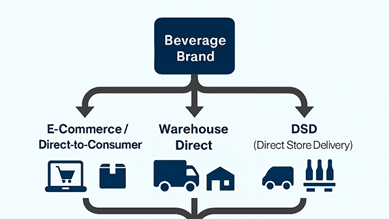
In part 1, we discussed the three primary routes to market for beverages along with the advantages and disadvantages of each approach. We briefly identified the RTM evolution of two highly successful beverage brands since 2020 and honed in on brands that have been successful in launching their brands using e-commerce to reach consumers. In part 2, we will pick up with discussing the two other primary RTM options and how the brands evolved into this approach to reach consumers.
Although Olipop, Hint and G-Fuel are among the most successful brands launched through e-commerce, it is more common for new brands to seek a Warehouse Direct (WD) model in order to gain availability in large format retailers. There are several companies that utilize this as their primarily route-to-market while others have evolved from WD to DSD. In deciding which model is best, it is important to understand what is required to succeed in either WD or DSD. In WD, an internal sales organization which is complemented by Brokers is the most common sales support utilized to service the channel. Although the cost to service is lower than DSD, the supplier must create consumer demand or risk being delisted by retailers. The most successful brands that leverage this approach to market include Sparkling Ice, Olipop and Spindrift.
- Sparkling Ice was a little-known brand when it approached Costco in the mid-1990s. Capitalizing on the Perrier recall, Sparkling Ice gained availability in the store and expanded to other large format retailers. The brand grew to achieve nearly $200 million in revenue by 2010. By 2015, the business took the next step and pursued DSD distribution so expand beyond large format retailers. The company revenues are approximately $1 billion today with business split skewed toward DSD although WD still plays a role.
- Olipop leveraged the perfect storm of on-line awareness and health consciousness that emerged during covid in 2020. Utilizing WD, the brand was able to drive distribution to major retailers such as Target and Walmart as consumers were searching for health-oriented products. Through the WD model, the company was able to go to market with a lean staff driving profitability. In 2024, the company was able to achieve an estimated $400 million in revenue and a valuation of nearly $2 billion based on a recent fund raise. Olipop has yet to develop a mainline DSD network to expand its retail coverage.
- Spindrift was launched through food service and WD in 2010. The company focused on clean label with targeted accounts. Its RTM continues to focus on WD model in which the increased margins are reinvested back in the brand through innovation and strong social media platform. The brand has grown to approach $400 million in revenue today.
The most comprehensive and expensive route to market is Direct Store Delivery (DSD). In beverages, DSD services between 700,000 and 1 million accounts. If vending is included, this would take the number upwards of 1.5 to 2.0 million; while WD services approximately 120,000 to 150,000 stores. The vast majority of the DSD accounts are small format stores such as convenience and foodservice (restaurants, bars, etc.). Aside from reach, full service providers will also manage the shelfs in accounts, build displays and manage logistics This system is best suited for well-known brands or single-serve–oriented categories, such as energy drinks that skew toward small-format outlets. The large systems are dominated by the three large soft drink companies: Coke, Pepsi and KDP. While beverage alcohol distributors are now entering the beverage distribution business to leverage the infrastructure they have in place. Beverage alcohol by law is required to sell through distributors in all states with limited carve outs.
In summary, the best RTM approach is dependent upon where a product is its development and what category it competes. If we go back to our original example regarding Poppi and Olipop, one can see the benefits of both approaches. Poppi was able to kick start its growth by servicing the small format accounts via DSD. At the same time, this came with a cost to included additional manpower needed to service accounts and manage distributors and margin paid to distributors to provide the service. While Olipop did not need to incur this cost. From a margin perspective, Olipop is more profitable on a per unit basis than Poppi. Until a certain scale is achieved to leverage the increased velocity, profitability will be moderated. This is evident in Poppi having 25% greater sales revenue but valued at roughly the same level as Olipop. In the end, both were able to manage expanding growth and profitability indicating that both RTMs work. A few key questions will determine which approach one should follow:
- How well capitalized is the business?
- What channel does my brand’s competitive set sell best?
- How best to enhance brand image, e.g. health channel or mainstream channels?
- Can I effectively use e-commerce to elevate awareness?
- Is my product different enough to generate interest from retailers?
- Do I have access to brokers to help access retailers?
- Can distributors open up channels and which type of distributor is best?
In the end, understanding your brand, where you want to compete, your short and intermediate objectives and the current stage of you brand development will determine which RTM is best for you.