
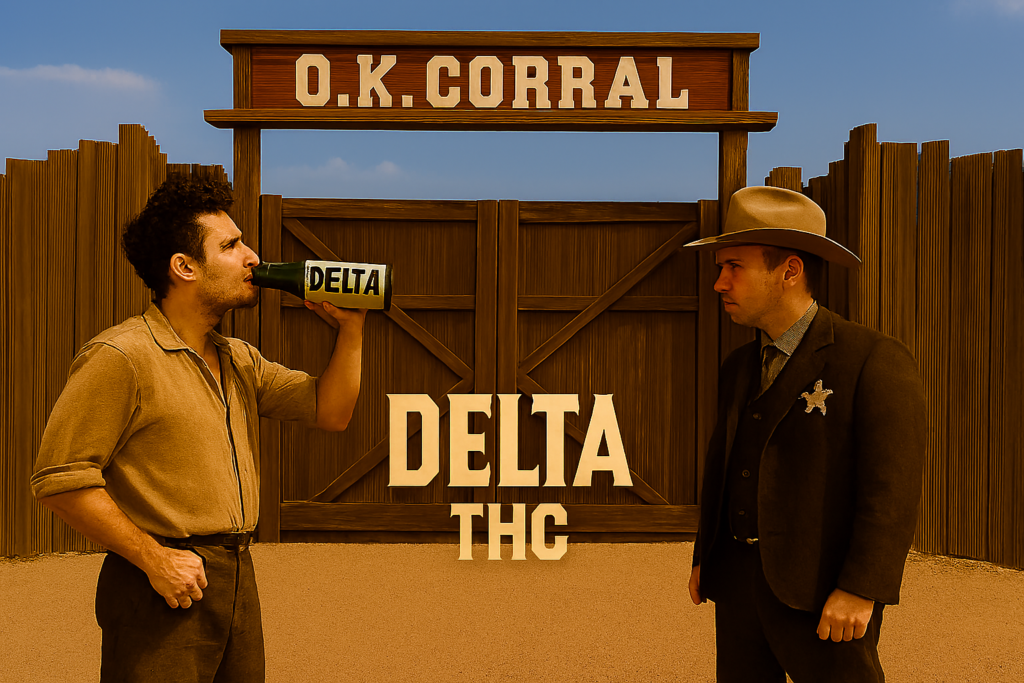
Hemp Beverages at “The Okay Corral”
By: Brian Sudano
The Hemp Beverage Industry was dealt a major setback with the Farm Bill loophole for intoxicating hemp ingredients being closed. A one-year grace period allows the sector to propose potential solutions for protecting consumers. The industry is estimated to reach $4B by 2028, according to Euromonitor(1), and contributes to local economies in several areas as well as the potential for tax revenue. However, health concerns loom as there have been studies indicating that the incidence of children being poisoned by editable (includes beverages) Hemp derived THC is on the rise (2) . The American Poison Center tracked over 2,500 cases of poisoning of children, 0 -19, in the first 4 months of 2025(3). The American Academy of Pediatrics has also reported on the rise of cases in which children have been poisoned by different Delta THC beverages (4). Although surely there are healthcare costs associated with the use of intoxicating hemp, but they are either not compiled or have not been published.
The Hemp industry trade groups suggest that adopting a beverage alcohol-style regulatory framework to include: product limits, age restrictions, taxation restrictions on e-commerce. Dosage caps and package size rules remain an open issue with several proposals floated to limit the amount of THC consumed from a single package. Attempts to regulate based on % delta-9 THC faces the issue of “what 0.3% of a 12 ounce beverage represents”. However, THC comes in different forms: Delta 8, Delta 9, etc. among others with a different impact. It is not as simple to just limit THC. Critics cite lax CBD enforcement as precedent, warning of a “wild‑west” market.
DUI enforcement is another challenge that has become a sticky point. THC can be detected for 24 hours in saliva and up to 90 days in hair, complicating impairment tests. Cannabis accounts for ~1 in 5 DUI cases according to Gitnex Marijuana DUI Statistics in 2025, despite the industry being far smaller than alcohol. Unlike alcohol, THC’s fat‑soluble nature means slower onset, longer duration, and cumulative effects. This differs from alcohol which the effect of multiple drinks is felt immediately. Another big difference is alcohol is the only ingredient of concern in alcoholic beverages while multiple cannabinoids and potential interactions with other ingredients, such as terpenes, remain poorly understood in the cannabis and hemp products. Education around these factors will be critical for the industry to avoid gain approval.
The debate is framed as a showdown: economic opportunity versus public health risk. The industry has a broad set of players that will need to come together. They have one year to craft a balanced solution, but success depends on collaboration across stakeholders. It is not as simple as copying beverage alcohol’s model.
Footnotes:
- https://www.cannabisindustrydata.com/u-s-hemp-derived-thc-beverage-market-projected-to-reach-4-1-billion-by-2028/
- https://www.nytimes.com/2025/08/10/health/cannabis-poisoning-children.html?smid=url-share
- https://poisoncenters.org/track/edible-cannabis
- https://publications.aap.org/pediatrics/article/153/6/e2024065881/197223/Cannabis-Legalization-and-Resource-Use-for?autologincheck=redirected